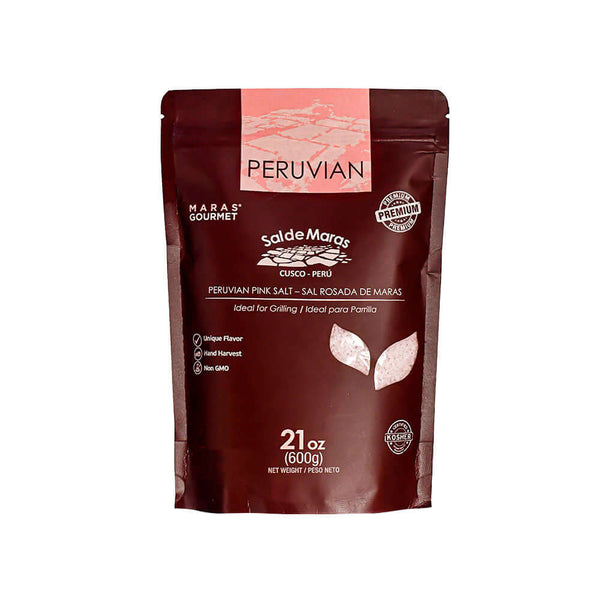
Peruvian Pink Salt
- Natural spring salt from the Andes
- Sun-evaporated and hand-harvested
- Naturally rich in minerals
- Mild, unique gourmet flavor
Free shipping on orders over $49
Thousands of sun-filled salt ponds, harvested by hand since Inca times. The origin of our 100% natural, mineral-rich pink salt.
In the province of Urubamba, Cusco, a mountain is carved into thousands of white terraces that change color with the light at every hour of the day. These are the Maras Salt Mines, on the slopes of the Qaqawiñay mountain, in the heart of the Sacred Valley of the Incas.
Just outside the small town of Maras, about 40 km from Cusco, they are one of the most remarkable places in the Andes: a pre-Hispanic activity that has sustained generations of native communities, including the Incas.
The Maras Salt Mines are made up of about 4,200 ponds, each just a few square meters. Salt water from a spring inside the mountain fills them, and the sun slowly crystallizes it into Maras Pink Salt.
For hundreds of years, and for hundreds more, this place has produced a 100% natural spring salt. The care of the local communities in keeping production artisanal has made Maras salt the economic livelihood of its people for centuries.
Table salt, sea salt, Himalayan salt… which one to choose? Here is what makes Maras Salt different: a natural spring salt with a naturally high mineral content and a unique flavor.

 Harvest season · after the rains
Near Cusco, high in the Andes, the town of Maras found its fortune in salt. The process is the same as centuries ago:
A natural spring of salt water flows from the heart of the mountain.
Small channels carry the water to thousands of ponds across the hillside.
The sun evaporates the water and the salt crystallizes: Maras Pink Salt.
Salt can't be harvested all year round. Work only begins once the rainy season ends, which makes Peruvian Pink Salt even more special.
“The salty spring that flows from the mountain is said to be the tears of Ayar Kachi.”
According to Inca mythology, the god Wiraqocha brought four brothers out of a cave to found a great empire. One of them, Ayar Kachi, was so strong that a single stone he threw could split a mountain.
Fearing his power, his brothers tricked him back into the cave and sealed it, so he could never become the founder of the empire. His tears ran down the mountainside and created the beautiful terraces we know today: the Maras Salt Mines.

Coarse grain
Big, crunchy crystals for steaks, BBQ and roasted vegetables. Grind fresh or sprinkle as a finishing salt.

THE · ANCESTRAL · FLAVOR